Navia Psikoloji
#Film Analysis
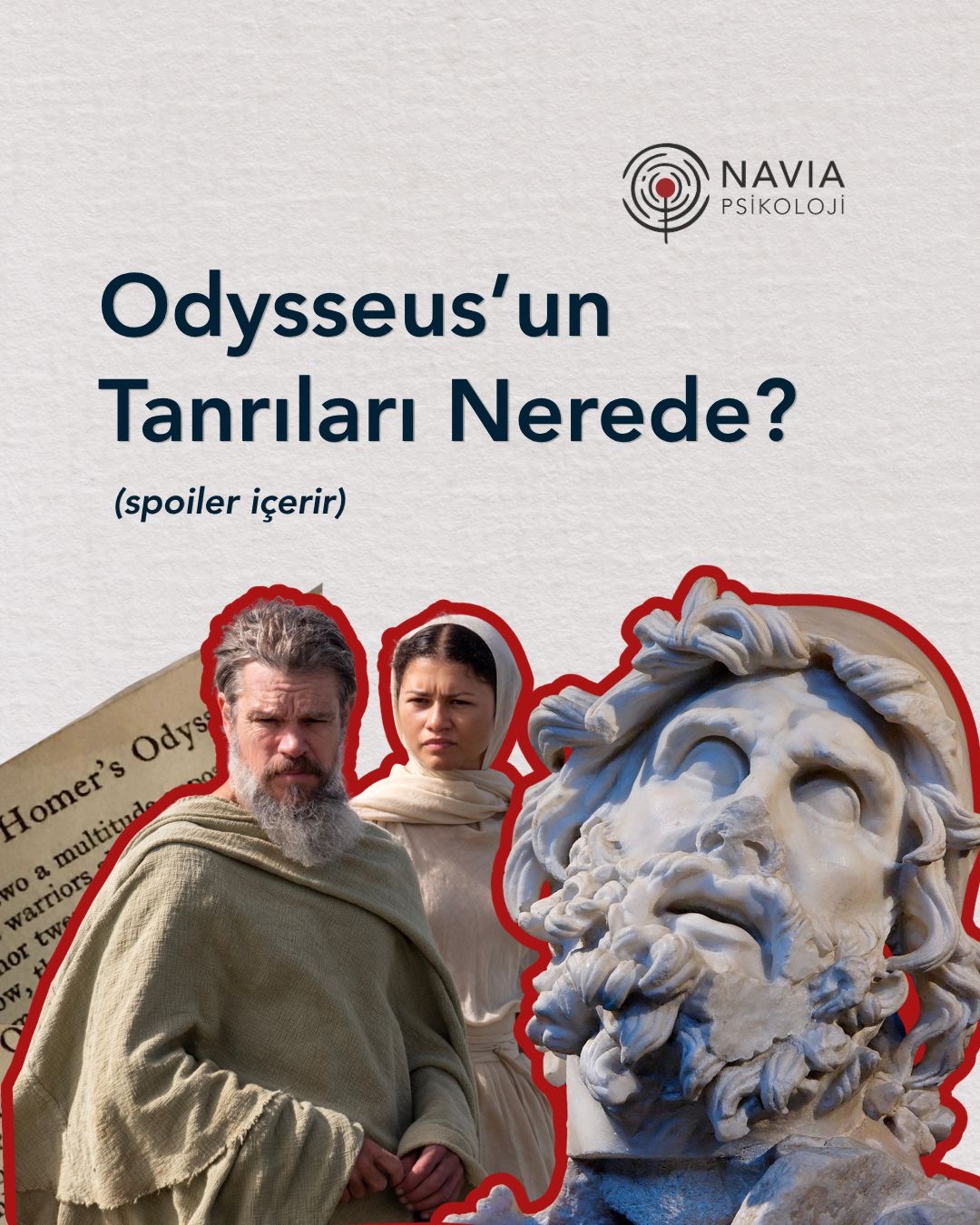
Where Are Odysseus’s Gods?

One of the most striking aspects of The Odyssey film is the absence of the gods who are present almost everywhere in Homer’s poem.

They are not entirely absent. Their names are mentioned, and they are spoken of, but they no longer intervene directly in the story as they do in Homer’s telling. They do not make decisions, punish, or offer their help. This seemingly minor difference profoundly changes the meaning of the story.

For example, in Homer’s account, Odysseus is able to resist the enchantment of the goddess Circe because Hermes warns him of the danger and gives him a plant called moly to protect him. Hermes tells Odysseus what Circe does and gives him the means to resist her magic. In the film, however, Hermes is nowhere to be found. Odysseus distrusts the food Circe has prepared and resists the spell through his own intuition, courage, and vigilance, ultimately saving both himself and his men.

A similar transformation takes place with Calypso.

In Homer’s account, Odysseus’s departure from Calypso’s island is made possible by Zeus’s decision and Hermes’s intervention. In the film, however, there is no divine command. Instead, there is Odysseus’s conscience.

Odysseus, whose only wish is to return home to his beloved wife Penelope and his son, suddenly realizes—with bewilderment and pain—that he has spent years on an island with Calypso and has forgotten everything else. The fact that a person can suddenly become aware of something they have been immersed in for years brings to mind certain psychic processes and moments of insight that we encounter in therapy.

The Lotus flower that makes him forget everything, in turn, evokes the defense of denial that many people resort to in order to cope with pain. What Odysseus is trying to escape through this profound act of forgetting is, ultimately, his guilt.

As the man who conceived the idea of the Trojan War, he carries a profound sense of responsibility for the devastation inflicted upon the city and its people. His guilt becomes an obstacle to his desire; the destruction that once took place outside him is now directed inward, toward the self. He becomes unable to experience the reunion he longs for.

Once again, we see Odysseus caught in a form of psychic conflict that could belong to any human being: a man whose desire is under attack by guilt and who therefore cannot reach fulfillment. Indeed, throughout the film, what we initially take to be Athena’s watchful gaze is ultimately revealed to be a representation of the remorse that refuses to leave him.

In the poem, the gods are the primary forces determining what happens to the hero. Their anger, their mercy, their assistance, their punishments—everything happens because of the gods and through the gods.

In the film, however, we find both the gods who punish and bring about destruction, and those who forgive and open the way home, within the human being himself, somewhere close to the conscience.

The gods are no longer on Mount Olympus. They are within us.

Perhaps the greatest battles are no longer fought at Troy or in the temples of Athena, but within the human being.
Navia Psikoloji
#Film Analysis
On Loss and Mourning: Fleabag and the Hot Priest

Fleabag’s encounter with the Priest takes place at a time when she is still immersed in mourning following the losses of her mother and her closest friend, Boo. For this reason, reading their relationship simply as an “impossible love” would be reductive.


In the aftermath of these losses, Fleabag has not yet been able to fully mourn. She is struggling with guilt, anger, longing, and aggression directed toward herself. In her relationship with the Priest, she forms a genuine intimacy with another person in which she is able to withdraw many of her defenses. She can remain vulnerable without having to hide it; the Priest sees her as she is. For Fleabag, who has rarely felt truly seen by anyone, the space opened up by this relationship is deeply significant. Everyone—and perhaps her father most of all—seems to regard her as difficult or maladjusted, whereas the Priest loves her precisely in these aspects of herself. Throughout the series, he is also the only character who notices that she is breaking the fourth wall.


Fleabag’s ability to see the Priest not merely as the person who sees her, but as a person with his own conflicts, impasses, and vulnerabilities, turns their relationship into a genuine encounter. They find in one another a kind of intimacy, recognition, and possibility for relating that is rare to come by. As viewers, we find ourselves wishing that, despite all the impossibilities, they could somehow hold on to this relationship. Because what we are witnessing is a genuine intimacy, even if it cannot be sustained.


What deserves perhaps the most reflection in the story of these two characters is mourning. Losses, separations, and the mourning we are able to do for them cause pain, but they also contribute to our growth. Beginning with our earliest objects, we gradually lose many of the things that make our relationship with ourselves and with the world possible. To find one’s own way is, to some extent, to become capable of living with what can no longer be brought back.


In this sense, some relationships become spaces in which previously unprocessed mourning can be reenacted. The loved person enters the subject’s psychic world both as themselves and as someone who carries traces of objects lost in the past. Love, in this sense, may be not only a turning toward a new object, but also a way of encountering one’s own history of objects once again.

This is part of what makes the relationship between Fleabag and the Priest so compelling. They establish a deeply intimate and reciprocal connection, yet this intimacy cannot become a relationship in which they choose to build a life together. The Priest remains within the life he has chosen, while Fleabag is left to confront his absence. Moreover, the impossibility of their relationship is not an obstacle that emerges later; it is a boundary the relationship has carried from the very beginning. They can see one another, but they cannot build a shared life.

The end of the relationship is therefore more than a romantic disappointment. For Fleabag, it is the experience of another profound loss. The Priest becomes part of a psychic history already marked by earlier losses, and his loss reawakens them. We see Fleabag both suffer and, at the same time, come to accept the path the Priest has chosen.


When a person becomes able to remain with the absence of the object in experiences of loss, they can begin to mourn rather than deny the loss or replace what has been lost with a substitute. We do not know whether Fleabag is able to mourn this time. Perhaps this is one of the most important questions the series leaves us with:

Has Fleabag, through the loss of the Priest, reached a place where she can carry not only the loss of him, but also the earlier losses that have been reawakened alongside him—where she can live with his absence and allow herself to mourn?